
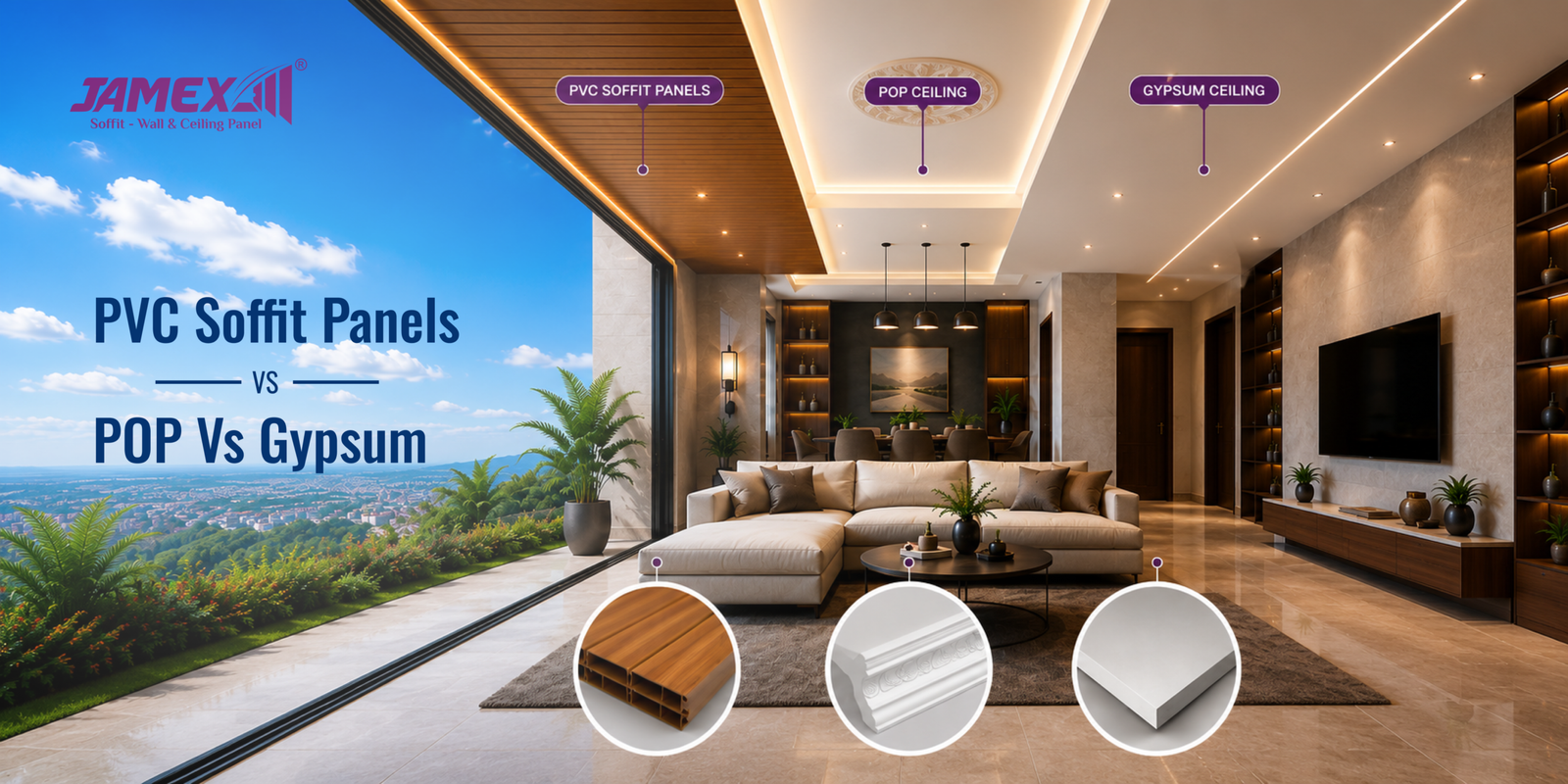
For decades, a false ceiling in India meant one of two things: POP or gypsum board. Both are well understood, both have a large pool of trained labour, and both still make sense in the right situation.
PVC soffit panels are the newer option, and they solve a specific set of problems the older two never did: moisture, drying time, and access to whatever sits above the ceiling.
None of the three is simply better than the others. What matters is the space, the timeline and the conditions the ceiling has to survive. Here is an honest comparison.
Quick Comparison
| PVC Soffit Panels | POP | Gypsum Board | |
| Installation | Dry, no curing | Wet, on-site | Semi-wet, jointing needed |
| Drying time | None | Several days | 1–2 days for joints |
| Moisture resistance | Excellent | Poor | Poor to moderate |
| Finish | Factory finish, no painting | Painted after curing | Painted after finishing |
| Design flexibility | Panel profiles, linear | Curves, mouldings, any shape | Flat planes, some curves |
| Service access | Panels can be released | Requires cutting | Requires cutting |
| Maintenance | Wipe clean | Repaint periodically | Repaint periodically |
| Site mess | Minimal | Significant dust and slurry | Moderate |
| Material cost | Higher | Lowest | Moderate |
What Is a POP False Ceiling?
POP plaster of Paris is mixed with water on site and applied over a framework, then smoothed, cured and painted. It is the oldest of the three methods and still the most flexible in terms of shape.
Where POP wins
Nothing else matches it for curved and moulded work. Cornices, coves, domes, recessed pockets, layered profiles if the design calls for a shape, POP can produce it. Material cost is also the lowest of the three.
Where POP struggles
It is a wet trade. The ceiling needs several days to cure before painting, the site gets covered in dust and slurry, and everything below has to be protected. POP absorbs moisture, so it is unsuitable for bathrooms, balconies, kitchens or any humid area it stains, softens and eventually crumbles. Hairline cracks along joints are common as the building settles. And once it is up, reaching a pipe or a cable above it means breaking the ceiling and re-plastering.
What Is a Gypsum False Ceiling?
Gypsum board is factory-made and fixed to a metal grid. Joints are taped and finished, then the surface is painted. It is the standard choice for large flat commercial ceilings.
Where gypsum wins
Because the boards are factory-made, the surface is consistent and genuinely flat better than hand-applied POP over a large span. Installation is faster than POP, and it covers large areas efficiently. It takes paint well, so any colour scheme is possible.
Where gypsum struggles
It is still a semi-wet process. Joints have to be taped, filled, sanded and finished before painting, which adds days and produces dust. Standard gypsum board is vulnerable to water a leak from above will stain it and, if the board gets saturated, it sags and has to be replaced. Joint cracking is common over time. Like POP, service access means cutting the ceiling.
What Are PVC Soffit Panels?
PVC soffit panels are factory-finished panels that lock into one another and fix to a supporting framework. There is no plastering, no jointing compound and no painting the finish arrives with the panel.
Where PVC panels win
The installation is completely dry, so there is no curing period and no wet mess. A ceiling can be installed and the space used the same day. The panels are waterproof and termite free, which makes them the only one of the three genuinely suited to bathrooms, kitchens, balconies, porches and covered exteriors. Maintenance is a wipe with a damp cloth with no repainting cycle. And because panels interlock rather than bond, they can be released to reach services above and refitted afterwards.
The factory finish is also consistent. There is no dependence on the skill of the person painting on site.
Where PVC panels are limited
The look is linear. Panels have visible joint lines, and while profiles vary flat, grooved, wave, vertical blade, slim they cannot produce the free-form curves and moulded cornices that POP can. Material cost per square foot is higher than POP, though the gap narrows once you account for POP’s labour, painting and maintenance costs.
If your design depends on a seamless curved ceiling, PVC panels are the wrong tool.
Head to Head
Installation time PVC is fastest dry fixing, no curing. Gypsum is next. POP is slowest because of the curing period before painting.
Moisture PVC is the only one suitable for wet and humid areas. POP and standard gypsum both fail in these conditions.
Appearance POP for curves, mouldings and seamless surfaces. Gypsum for large flat painted planes. PVC for texture, profile and a factory finish its joint lines are part of the design rather than a flaw, in the way timber cladding lines are.
Maintenance PVC needs cleaning. POP and gypsum need repainting on a cycle, and touching up where cracks appear.
Service access PVC panels can be released and refitted. POP and gypsum must be cut and made good.
Which Should You Choose?
| Situation | Best choice |
| Bathroom, kitchen, utility | PVC soffit panels |
| Balcony, porch, roof overhang | PVC soffit panels |
| Occupied home or working office | PVC soffit panels — no wet trade or downtime |
| Services need regular access | PVC soffit panels |
| Curved or moulded decorative ceiling | POP |
| Cornices and layered profiles | POP |
| Large flat commercial ceiling, painted | Gypsum board |
| Tight budget, dry interior | POP |
| Textured or wood-look ceiling | PVC soffit panels |
Many projects use more than one. A living room might have a POP cove with a PVC panelled centre; a home might use gypsum in the bedrooms and PVC panels in the balcony and bathrooms. There is no rule that a building must choose one system throughout.
Frequently Asked Questions
1.Is a PVC false ceiling better than POP?
For wet areas, fast turnarounds and ceilings that need service access, yes. For curved and moulded decorative work, POP remains the better option.
2.Which lasts longer — PVC, POP or gypsum?
PVC generally holds up longest in humid conditions because it does not absorb moisture. In dry interiors, all three last well if properly installed, though POP and gypsum need periodic repainting and crack repair.
3.Is PVC ceiling more expensive than POP?
Material cost is higher. Total cost is closer than it appears once POP’s labour, painting and ongoing maintenance are included.
4.Can PVC panels be used in bathrooms?
Yes. They are waterproof and termite free, which makes them well suited to bathrooms, kitchens and other humid spaces where POP and gypsum fail.
5.Which false ceiling is fastest to install?
PVC soffit panels. There is no curing or drying period, so the space can be used immediately.